

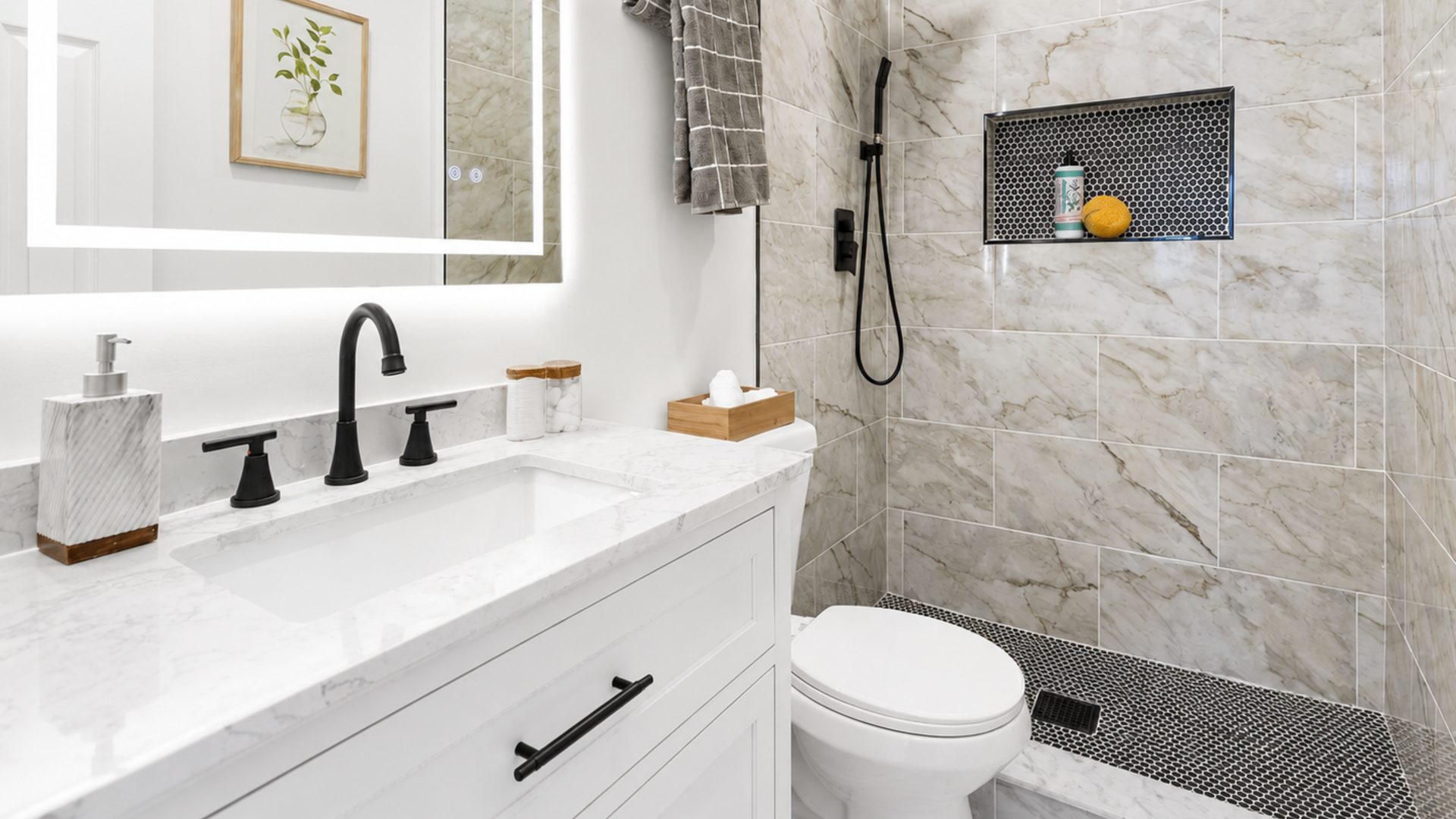
Bathrooms are the project we get asked about more than any other, and the one where online numbers are least useful. Remodeling magazine's Cost vs. Value report puts a midrange bathroom remodel in the Washington metro at about $25,000, but that figure describes a 5 by 7 bathroom with basic fixtures and a solid surface counter. Almost nobody we meet is buying that bathroom. So here are the numbers from our own 2026 quotes across Fairfax, Arlington, Alexandria, Vienna, Falls Church and the Richmond area, and what sits inside each tier.
$8,000 to $17,000 · Tub to shower conversion or a targeted update
The layout stays where it is. The tub comes out and a walk-in shower goes in with a new valve, tiled walls, a proper waterproofing membrane and a glass door. Or, in a small bath, a new vanity, floor, toilet and fixtures with the existing shower left alone. This is the tier for a bathroom that works but has one thing you cannot live with anymore, and it is where most of our conversion quotes land.
$18,000 to $38,000 · Full remodel, same layout
Everything comes out to the studs. New tile floor and shower, vanity and countertop, toilet, lighting, exhaust fan, trim and paint, with the plumbing and electrical brought up to code wherever they are exposed. The fixtures stay roughly where they were, so there is no rerouting of drain lines and the permit is straightforward. Most of the single bathroom quotes we wrote this year sit inside this range, with the middle of it around $28,000 to $33,000.
$35,000 to $60,000 · Primary bath with layout changes
This is where a wall moves or the plumbing does. A curbless shower with a built-in bench and niches, a freestanding tub, a double vanity, heated floors, custom glass, and often a closet that gets absorbed to make the room bigger. When a wall is load bearing an engineer signs off on it. Most of the "before and after" primary suites people picture live in this tier.
$55,000 to $75,000 · Two or three bathrooms at once
Doing the primary and the kids' bath, or all three bathrooms in the house, in one project. The crew is already mobilized, the materials arrive together and the plumbing gets addressed as one system, which is why two bathrooms rarely cost double one. Older homes often add a repipe or a new water heater here while the walls are open.
The four things that move your number the most
Tile. The material itself and, more than people expect, the labor. Large format porcelain, marble and mosaics take longer to set and cut than a standard 12 by 24 tile, and a shower with three niches and a bench is a different job from a plain surround. Choosing tile with a realistic allowance and upgrading only where you will see it every day is the easiest way to keep the number in range.
Whether the plumbing moves. Keeping the toilet, the drain and the shower valve where they are avoids opening the floor and the ceiling below. Moving them buys you the layout you actually want, which is often worth it, but it is the decision that jumps you from one tier to the next.
What is behind the walls and under the floor. In the last two weeks alone we quoted two bathrooms where the subfloor had rotted under a slow toilet leak nobody knew about. Failed waterproofing, old galvanized pipe and undersized wiring show up in homes built before 1990 all the time. A good contractor tells you this is possible before you sign and prices it as a written change order if it appears, not as a surprise on the final invoice.
Glass, fixtures and the tub. A frameless glass enclosure, a freestanding tub with a floor mounted filler, a thermostatic valve with a rain head and a hand shower: each of these is a real line on the quote. None of them are required for a beautiful bathroom, and all of them are worth it if you use them daily.
How long it actually takes
Once you sign and make your deposit, we schedule a design intake with our design director, and the first 3D renders are usually ready within 5 to 7 business days. If the county requires a permit, that is 1 to 3 weeks depending on their load. From there the crew is onsite within about 10 business days, and a same layout bathroom is typically 2 to 3 weeks of construction, 4 to 6 when walls or plumbing move. In practice that means a bathroom signed in September usually lands before Thanksgiving, and October signings are the last ones that comfortably finish before the holidays.
How to compare quotes without getting burned
The cheapest quote is almost never the cheapest project. When you compare, look at what each proposal actually includes: is the tile a specific product or an allowance that gets "adjusted" later? Is waterproofing spelled out, or just "install tile"? Are the vanity, glass and fixtures in the number? Are permits included? Is there language for the unexpected, or will every surprise become a change order at whatever price the contractor names that day?
On our projects, every material and every dollar is in writing before work begins, and you see a photoreal 3D design of your finished bathroom before we touch anything. That way the number you approve is the number you pay, and the bathroom you imagined is the bathroom that gets built.
If you want a real number for your bathroom, not a range, we are happy to put one together. No obligation, and the 3D design is free.
Price tiers are drawn from DFC Home Improvement quotes written in 2026 for homes in Northern Virginia, DC and the Richmond area; your project will vary with size, selections and existing conditions. Industry benchmark: Remodeling magazine, Cost vs. Value report, Washington DC metro, midrange bathroom remodel.